Become a Citizen Scientist for the easyPEST
30.07.2026 12:11
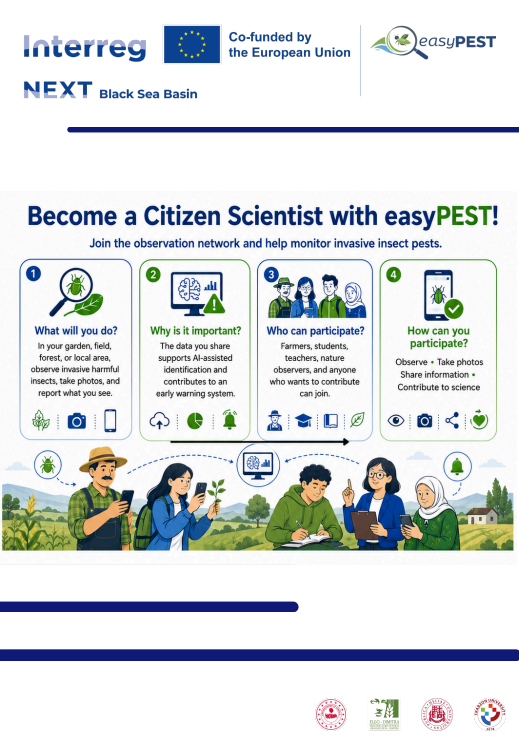
If you love observing nature, are curious about changes in your environment, and want to contribute to scientific studies, you can join the easyPEST citizen scientist network.
Carried out under the coordination of the Governorship of Giresun and co-financed by the European Union under the Interreg NEXT Black Sea Basin Programme, the easyPEST Project brings together volunteer citizen scientists for the early detection and monitoring of the spread of invasive pest insects.
Executed through the collaboration of institutions from Türkiye, Greece, and Georgia, the project aims to identify invasive insect species that threaten agricultural production, biodiversity, and wildlife more rapidly.
Thanks to the artificial intelligence-powered mobile application to be developed within the scope of the project, citizen scientists will be able to take photos of the insects they encounter in their surroundings and upload them to the system. In this way, while observing nature, they will contribute to the generation of scientific data and the development of a regional early warning system.
Who can apply?
Anyone who is interested in nature and wishes to contribute to scientific research—especially farmers, students, teachers, nature observers, and public and local government employees—can apply to become a citizen scientist.
Selected volunteers will receive training from experts on biodiversity, climate change, invasive alien species, nature observation, and the use of the mobile application.
Following the training sessions, citizen scientists will support easyPEST’s early detection and monitoring efforts through observations conducted in gardens, fields, forests, and everyday living spaces.
The data provided by citizen scientists will contribute to tracking the spread of invasive species, identifying high-risk areas, and developing the AI-powered recognition system.
By observing nature together, we can contribute to protecting agricultural production, supporting biodiversity, and creating a more resilient Black Sea Basin.